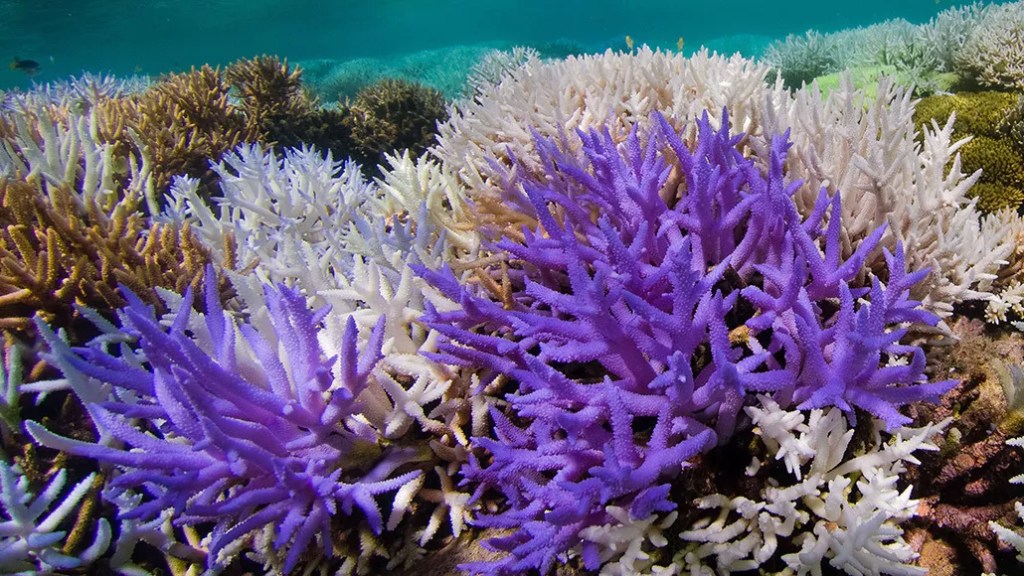
It’s the nature of beauty to be fleeting. From the changing nature of the seasons to the elaborate ways the Earth renews herself in her own time, human capabilities have been able to unearth some of these cycles. Our planet, however, isn’t prepared to deal with the scale of changes that are occurring as a result of anthropogenic stressors.
The rapid increase in ocean temperatures and the rampant speed at which societies are exploiting our oceans is leading to mass coral bleaching events around the world. The warming waters are not the sole thing to blame, however. The runoff from agricultural lands as well as nutrient stress are known to be significant factors causing these lifeless wastelands.
Coral reefs are one of the most beautiful examples of a community that thrives as a result of an equal reciprocity. Unicellular dinoflagellates shelter themselves in the coral population’s gastrodermal cells, while in turn being provided with the nutrient support they need as well as adding an aesthetic value that drives so many of the tourist economies. Bleaching events occur when this symbiotic relationship is broken down, leaving the coral skeletons bare. When this happens, the light that travels to the corals is not absorbed due to an absence of the photosynthetic pigments. This incident light continues to dance inside the skeletons before ultimately being reflected back into the atmosphere, leaving the corals white, ghastly, lonely, exposed.
Thankfully, nature has a way of catching one’s attention at the brink of death. This has been proven over and over again, be it amongst the colorful rivers in Romania as a result of copper runoff, the presence of dolphins and swans in the Venice canals during the Covid-19 pandemic, or the colorful bleaching of corals.
All around the world, ranging from Palmyra Atoll to the Great Barrier Reef in Australia, researchers from University of Southampton have observed a recurring pattern amongst dying corals: their ability to glow in the neon light. They have found this to be the case in about 40% of the reef that covers the shallow waters.
To better understand the mechanism of action and the advantages that these colorful bleaching events provide, the researchers used the available satellite data to recreate the heat stress levels within their controlled lab environment. They observed different coral reef populations respond differently depending on the amount and the time of heat stress that they underwent. For example, the reefs from Lizard Islands in Okinawa displayed colorful bleaching 17-25 days after exposure to the heat stress, while the Palmyra Atoll bleached neon after about 12 days of recovering from the maximum temperatures. One consistent observation that the researchers were able to infer was how these events occurred immediately following recovery from extreme heat stress.
Further experiments conducted in the lab also confirmed how the increased pigments that these corals were harboring had a higher potential to help with recovery following extreme temperature events. However, this wasn’t always the case. Balance is the key to thrive in life, and corals are the perfect microcosm of that idea. In their initial analysis while conducting the research, they also found that some reefs that underwent colorful bleaching in the Philippines initially ended up bleaching white after prolonged exposure to high temperatures. This further solidified the idea that the majority of the time, the colorful bleaching is the result of the corals starting to recover, as the increased light fluxes can actually work to minimize further heat stress and promote recolonization by the dinoflagellates.
2021-2030 is the Ocean Decade as declared by the United Nations. New strategies and planned actions are continually being curated and undertaken with the major goals being to conserve the ocean and the marine ecosystems, to raise awareness regarding the importance of these aquatic systems, as well as lead to a productive, safe, resilient, and accessible ocean. I believe that knowledge and awareness about the ocean and their importance in our existence is essential, however, so is an inkling to drive us towards change.
During the Labor Day weekend last year, I managed to sneak in some time to commune with nature in this chaotic world that I’ve embraced in the midst of New York City. We got off the train station at Peekskill in upstate New York, and started walking along the highway to get to the trailhead. The sidewalk was lined by heaps of jointed goatgrass, which was occasionally interspersed by these beautiful bushes blooming with a 2-petaled, cerulean blue flower that caught my eye. Research showed that this is the Asiatic dayflower which, very fitting to its name, is an annual that grows for one day only. Despite these flowers being an invasive species on our continent, reading about their nature filled me with a sense of melancholy. This piece of writing is a result of attunement to the world as it unfolds around me. Our planet has a way of summoning us when it falls out of equilibrium, like a moth to a flame. What more is it going to take for us to answer this call?

